Wednesday 13th September 2006, Glasgow School of Art
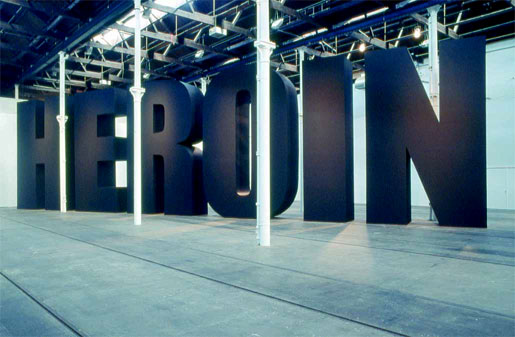
Joanne Tatham and Tom O’Sullivan are Glasgow-based artists who have worked collaboratively since 1995. They are perhaps known primarily for monumental sculptural works and installations such as HK (Tramway, Glasgow, 2001), The Glamour (2000, Transmission, Glasgow) A Routine Sequence of External Actions (‘Selective Memory’, The Scottish Pavilion at the Venice Biennale, 2005) and Rhetoric Works and Vanity Works and Other Works (Newhailes, 2006). Along with these works, Tatham and O’Sullivan’s expansive practice also encompasses creative writing as an important element of the visual art work they produce. Indeed, their practice as a whole invites many parallels with the structures, systems and strategies of language. The writing they have produced has functioned variously as an integrated component of their practice, as an additional, parallel activity and as stand-alone texts for other artists. Both Tatham and O’Sullivan have written collaboratively and as single authors. In this interview, Joanne Tatham discusses the place of creative and critical writing within works she has made with Tom O’Sullivan as well as the writing she has done for other artists. Through a discussion of particular works, the interview attempts to address the way in which words, language and writing function in the context of contemporary art practice and also seeks to investigate the role and position of creative writing as part of practice-based research.
Joanne Tatham graduated from the MFA at Glasgow School of Art and has completed a practice-based PhD, Heroin Kills: Context and Meaning in Contemporary Art Practice at the University of Leeds, 2004. Tatham and O’Sullivan are currently Research Fellows at Grays School of Art, Aberdeen
Susannah Thompson: Your visual art is very much in the foreground in terms of your practice. I wondered if you could say some more about your decision to begin writing as a parallel to your work or as a part of your practice. Can you tell me how it began and what the motivation was to begin writing?
Joanne Tatham: I think it goes back to the time that I started to develop a practice as an artist which was while I was doing an MFA at Glasgow [School of Art]. A lot of the work I was doing was very specifically concerned with language. In particular I was very interested in working with texts which were found texts so a number of works I was doing at the time were taking books and actually somehow reacting or reworking them or putting them into the first person. I think that was quite an important experience in a way because it allowed that possibility of text becoming the art work and it allowed me to have a slightly different relationship to words than the conventional place words had taken in my education up to that point. In that context, they were things that accompanied an art work – they surrounded an artwork. At that time words as part of a title were something that was a very important space within the construction of an art work and how it functioned out in the world. Again, there was a space in which words were found or manipulated or positioned to establish a particular meaning or direction. The writing that I initially wrote as an artist was about trying to forget about logic in a way and about trying to move forward creatively and develop writing that was more skilful or crafted. So there was an interim period where I was actually trying to learn how to use words in the way that I felt was useful or appropriate.
ST: Has that continued in your work? It certainly seems, especially in terms of what you were saying about titles, to be the most apparent way in which you developed that way of working.
JT: Yes, to go back to when I first started working with Tom, the first collaboration we did was a work in which the title was I Speak to the Sea and the Sea Speaks Back to Me, I Speak to the River and the River Speaks back to Me. Both of us felt it was very important to have a long narrative title that occupied a space which paralleled that of the art work. The art work itself in some ways was about adopting an almost ridiculously romantic position. There were portraits of us both in over the top landscapes and the title was trying to mirror the slightly ‘over the top’ quality of the landscape. That mirrored approach to titles has continued through the practice. The complexities of what you can actually do with those words that go with the work is something we’ve tried to develop and consider further
ST: To come back to something you’ve already mentioned, you’re known now for your collaborative work with Tom O’Sullivan but a lot of the writing that I’ve read is under your name alone. What are the differences between your approach to writing and art?
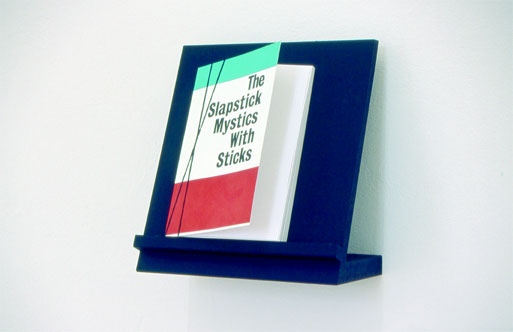
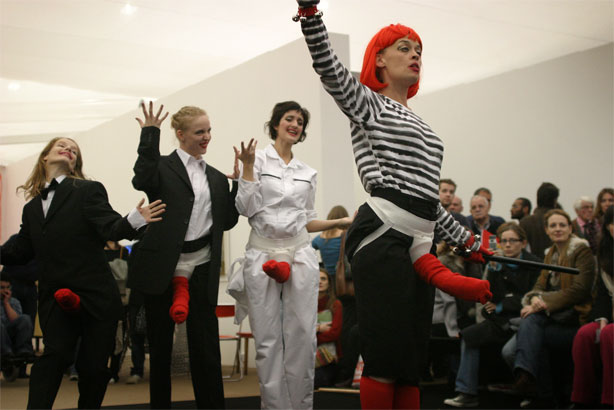
JT: It’s something that myself and Tom are still trying to establish. What are the parameters of the collaboration? I think for us the collaboration has always been about a very generous kind of inclusivity, so that’s allowed us to have quite an expansive practice. We have done some of the written works under the name of the collaboration. One of us might have written them and sometimes we’ve written them together but its very important that it’s Joanne Tatham and Tom O’Sullivan who actually have the named authorship of that piece. So the title of Slapstick Mystics with Sticks, the novella and the play, were joint authored even though unfortunately it came to be known, probably through me and Tom not keeping our mouths shut, that I wrote the novella – sometimes these things get out. [Laughs]
ST: Yes, that’s something I was aware of. Your name wasn’t on the novella yet I knew somehow that you’d written it, even though it was part of a collaborative work, or one element of a collaborative work…
JT: I can’t really remember who wrote a lot of the texts we’ve produced to be honest. With The Grid, for example, I know I was involved in writing it to some extent and its possible I wrote all of it. I think its interesting within a collaborative situation where who did something doesn’t really matter because it’s the decision to put something out into the world that is the important part rather than who actually ‘did’ the work in the traditional sense. Recently I’ve been trying to make the separation between the collaborative writing and the writing that I’ve done myself. The writing that I’ve done under my own name is something that circulates around the PhD that I did and this is a slightly retrospective re-framing of that particular body of work. It is allowing me to think of the writing as a useful and productive project in its own right and not something that infringes on the terms by which me and Tom collaborate. So many of the pieces I’ve done, for example the piece for Alan Michael, very much grew out of the research and the things that I did while I was doing the PhD. I was trying to follow through ideas about how to write about art, rather than about how to position a piece of writing as an art work.
ST: What you’ve said reminds me of the introduction to Charles Harrison’s book on Conceptual Art and Painting where he was discussing the distinction between artists who write literature and ‘artist’s writing’. Do you have any affinity with an approach like that of Art and Language who, as conceptual artists, have employed writing as part of their practice?
JT: I don’t know. I feel that Tom could add to this as he was taught by Terry Atkinson and I was technically supervised by him for my PhD. In a very general sense all these practices act as models and as possibilities, but I never really felt an affinity with that way of working. There’s a difference in the way Art and Language saw words and the authority they gave to words whereas in much of the writing that exists within our collaboration words are used as you might use a scrap of paper that you found. To some extent that is a disingenuous thing to say because words are so loaded with reference and meaning. When I think about the background to our practice I’m really thinking very specifically about working alongside particular artists in Glasgow and the way they’ve used words, materials and things they find around them to make art. Of course this isn’t a tradition or a moment exclusive to art in Glasgow in the last 15 years – to suggest that would be absolutely ridiculous …
ST: But they would be more of an influence than the approach taken by Art and Language?
JT: Yes.
ST: That brings me to some of the debates surrounding poststructuralist theory and the idea of using words as found objects. A lot of your work, particularly your more recent work, seems to be about quotation – quoting yourself, being self-referential and making works that refer back to earlier works or recomposing earlier works. Do you feel that you use language in a similar way?
JT: Yes, it would definitely function in a similar manner and I suppose as part of that quotation we have ‘word-works’. The process of re-using and re-framing particular works which are comprised of words has been quite an important strategy for us in terms of trying to disrupt how an art work can be interpreted and the expectations that surround the interpretation once words become involved. Something like Heroin Kills, or HK as its correctly titled, is a piece that very obviously tries to undermine its own specific interpretation but simultaneously re-affirm the specific interpretation through strategies such as the Tramway publication of interviews. But something like Slapstick Mystics was always about trying to have something which existed in both as a novella and a sculpture simultaneously and trying to create almost two possible ways of accessing a work. So you might interpret it in a literary way and actually read it in some sense as a specific allegory about interpretation but at the same time you might just understand it as a positioned set of found words – as a genre piece in a way. Trying to do both of those together seems a lot to expect but it was something we really wanted to try.
ST: Some of the work seems to be ironic and earnest, romantic and rational simultaneously, that there were these oppositions happening, but neither one cancels the other out. Could you expand on this?
JT: Yes, again I think it comes down to something quite fundamental about why I’ve chosen to use creative forms to write about art is because of the failure of the more conventional applications of words to describe art accurately. It always seems that that its easier than talking or writing an essay – certainly for me, with my limits as a writer, to avoid those dichotomies that will label something as this or that. There’s something peculiarly unsatisfactory about words and the conventions that we’re having to deal with now in that they only allow something to happen before something else happens. The great thing always with an art work is its ability to occur simultaneously in many different spaces at the same time, to be many things equally and exactly. I think somehow trying to negotiate that within our practice and writing around other sorts of practices is a result of my frustration with the limits of words for me. I think there are people who write really well about art but I think to do that in a more conventional, academic format is hard. It’s not as though people can’t achieve that but it almost predetermines the way you’re going to think about something really.
ST: … and the way you’re expected to fulfil certain criteria, build an argument or work in a formal way. Coming back to the question, I wanted to ask you about the different forms and styles of your writing. The text for Sophie Macpherson for the Greyscale/CMYK (Tramway, 2002) catalogue, which took the form of a poetic, literary letter, is very different to the coarse, conversational language and stream-of-consciousness style used for Alan Michael’s catalogue text1, while The Grid reads almost as a manifesto. Could you say something about why you’ve adopted these very stylised or opaque styles? Are you self-consciously attempting to pastiche established literary forms?
JT: To me these different forms, these genres seem to offer a vehicle through which you can experiment. I suppose it goes back to what I was saying about this idea of words being things that we find. In a sense I find a collection of words and then use them but I wouldn’t think about it quite as specifically as a pastiche – it’s not part of the process that I would actively, consciously seek out particular texts to use as a template, though there are pieces which have done that. I wrote a piece that was never published quite a few years ago which was quite obviously a skit based on Glamorama by Bret Easton Ellis. The piece I wrote about Alan Michael’s work came from thinking very hard about Alan’s work. Again, I don’t want to be disingenuous about that but it was about taking a visual clue that seemed quite absurd. I wrote it at the time Alan was doing quite a lot of the shoe paintings and I was trying to find a hint, a referent, that would be a gross misinterpretation of what Alan’s work is about. There seemed to be something about thinking about the shoes and trying to tell a story about shoes that got me onto the idea of tramps and then straight away I was into a realm where I had so much to plunder. The first place I probably went to was back to a text Tom had been reading – a Beckett piece – I can’t remember what it is – and one evening he almost bet me to see if I could actually read this huge rambling monologue within Beckett – I think I managed to read for about 45 minutes. It was incredibly enjoyable – there’s something about that process of reading something out and absorbing the rhythm and that encourages you to try and absorb it and spit it out but obviously what happens is that it comes out as something quite different. I also spent a lot of time researching jokes and the traditions of everyday vernacular and the use of language and anecdote.
Susannah Thompson: Yes, even the way it was typeset lends itself to being read in that way – the fact that there were no paragraphs encourages you to read it as this long rambling piece. Do you think there’s a difference between how you regard art and literature as cultural practices, in general and in relation to your own practice? A lot of your visual art works seems to question or parody the art world and it can seem very cynical or ironic but your writing, or at least some it, seems much more romantic or earnest in its tone, in particular the poems within ‘Form and Verse’ in Stop Stop. Do you think there’s a split or difference in your approach as a practitioner or visual artist? For instance would you say that you have a more emotional or romantic approach to writing and a more intellectual or rational approach to making art? Is there a division for you?
Joanne Tatham: I suppose I don’t feel that there is a division. Maybe it’s just a matter of interpretation but, for me, there doesn’t seem to be an awful lot of difference between those activities – making objects that exist out there as sculptures, pictures or paintings and making things that exist as printed texts or perhaps even spoken text. You mentioned that you saw the visual work as being somehow ironic but I don’t feel like that about it – in the past people have responded to the written work more in that way. Both the writing and the other things allow for a fine-tuned ambiguity that fluctuates between both those positions – they could be seen as being a pastiche or being cynical. It’s about trying to break down the idea about what exactly happens as the work is being made. When you talk about it being romantic or emotional it suggests a kind of directness but making something – especially working within the collaboration with Tom – doesn’t seem to genuinely reflect the processes that we actually engage in to get something made. I spoke before about the idea of writing something and it existing more as a performance and I think we try to make a lot of the work together almost as if it were almost a performance, performing a set of attitudes rather than expressing a set of attitudes directly. There’s no sense of a direct or immediate position coming through, it’s a much more self-conscious decision about adopting a subject position. That is one of the reasons we wanted to work together – we wanted to try to articulate something about the limitations of a single subject position and how that could feed into the interpretation of an art work.
ST: You’ve mentioned this to an extent when you were speaking about some of your earlier work with Tom around the time of your MFA in which you were doing something that appeared to be very overblown and romantic. In some respects it could be – it could be very earnest – but on the other hand it depends on the viewer as to how they interpret the work rather than having one fixed position that you’re trying to project.
JT: Yes, it’s interesting – I’m going back over 10 years since we first showed that work and it was curious in the first couple of years of our practice that there was a perception that we were specifically involved in certain areas of content or concerns such as nature, the mystical or the magical and actually we picked these particular areas because they were the most potent. They were the most appropriate conduits through which we could negotiate some of these really problematic things about romantic beliefs, about making art, about authorship, about the processes though which art gets made and how it’s subsequently interpreted. In HK it was very different. It was great to be doing something that was ‘about’ drugs as opposed to being about mystical beings or something.
ST: Can you give us any examples of that kind of work? Do you mean works like The Dwarf?
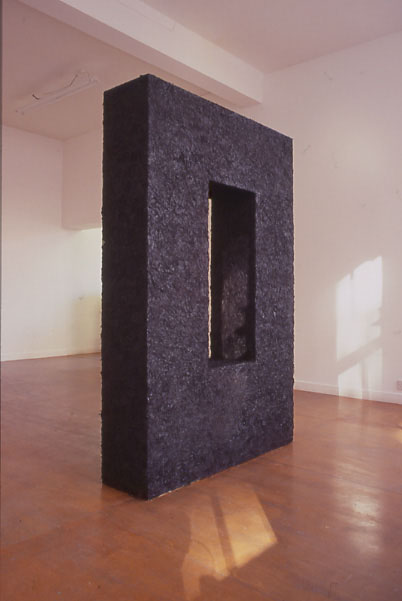
JT: We did a piece called The Dwarf; we did a piece called Magus and these were all quite overblown pieces with sound, music, lights. For us they were genre pieces, found genre pieces but I think they were often taken as being much more direct and I think the works we’ve done since then, in the last five years, often still draws on those things. The pyramids with hay round the mouth and strange patterns would be one example we’ve also tried to pull back a bit so that they also had a kind of coolness about them. We were trying to play it both ways and I think we did it more successfully perhaps than we had in the late 90s. I don’t feel that that’s something we’ve done quite as precisely in the writing in the collaborative practice as we have done in certain other forms.
ST: On that note, can we come back to the poems you did for ‘Form and Verse’? To me they read as though they were almost Bronte-esque. They’re romantic; they seemed to have references to animism, nature, allusions to the green and pagan ritual. Can you tell me more about how this work came about, and about the juxtaposition of image and text within the work?
JT: The poems were like a sequel or a kind of performances. We made the ceramics in the photographs first. They’d been made as a piece of work which was at the Showroom, a work called Resurrection with three forms. Often, as you’re making art you have to make work for the situations in which you can show it. In this case the situation was a book, Bent Aura, and so we went back to that performance and revisited it. We revisited the attitudes we were trying to enact – in that case making ceramics – and tried to get into the same mental space as someone who had made those ceramics would do if they were going to write a poem. But we did also try quite hard to avoid any specific clichés and that was one of the earlier pieces where we did write together and we wrote half the poems each. We were feeding off each other all the time as we were writing. We tried very hard in terms of the amount of involvement and care in the language of the poems to move beyond something that would be seen just as a pastiche. Hopefully it worked as more than a pastiche – it was written with more conviction than that. There’s a naivety to it and some of the thematic areas that you mentioned are ridiculously romantic in a way.
ST: They do seem to be very sincere. I think that really comes across.
JT: We really tried to write it like that and we re-photographed the ceramics as well and tried to photograph them in a way that seemed in keeping with those things. It’s always about trying to find a subject-position, one which was not ours but which was slightly to the side of ours. It wasn’t like we tried to write a profile of this kind of person but we did have a discussion of trying to work out what they would do. It wasn’t a pastiche of sixth form poetry but it had a hint of all that. Sometimes when people look at these works it’s possible to pick up on the most immediate reference point in terms of what the person behind the work might have done, but we’ve always hoped that it would be a little bit more complex to pull apart than that. One of the things about working over a period of time is that each of these narratives or performances contributes to the whole practice. I don’t mean in terms of finding a type or a style – it’s not as crass as that. It’s trying to make three dimensional characters that are behind the production of both the written work and the objects or images.
ST: It certainly didn’t seem that the images were illustrating the text in that work, it appeared to be much more interwoven. Coming back to the subject of pastiche, it’s hard for me to tell sometimes, in both the visual art and the writing, whether you’re presenting a parody, a pastiche or elements of both in terms of how your work relates to the machinations of the art world or various literary or cultural sources. Could you expand on this a little bit, in terms of how you might have presented a deliberate parody or pastiche rather than that simply being the way the work has been read?
JT: I think we’re concerned with trying to construct a framework that is recognisable in the sense that it can act as a system through which a viewer can start trying to unpick what on earth it is we’re trying to do. By returning to works and going back over them again what we’re doing is partly about trying to make more recognisable what it was we were doing the first time, so that the performance continues from one work to another. I think there’s something fascinating about the way in which you can leave something for a period of time and undermine or rework or rewrite the performance that went into the production of something. Anything that is fixed or seems to present one possibility of interpretation becomes something you have to go back and question …
ST: So in some respects you’re being quite generous towards the viewer by offering these points of access?
JT: Yes, I started off by saying that I was trying to construct a framework that opened the work up but as I’ve been talking I seem to have talked myself out of that and I’ve suggested that what we’ve been doing has also been about trying to confuse the viewer even further. I should add that I’m thinking about work and ideas that span ten years.
ST: As I’ve been thinking about your work and this interview I’ve been thinking about the fact that there is often a distinction in the way we understand the differences between language and literature. Clearly, they are two separate disciplines (one more scientific, one more akin to art) even though they are inter-related. Your work seems to encompass both simultaneously. My recourse as a writer is to go to literature to illuminate art I find difficult, which is interesting in terms of what you were saying about titles and how titles work in relation to art works. In trying to understand work that, like yours, functions in complex ways in terms of semantics and semiotics and fixed or fluid meanings, I was reading a quote by Ezra Pound which brought things together for me a little. In it, Pound is expounding his (flawed) theory on the difference between ‘Imagism’ and ‘Symbolism’ in poetry and he writes: ‘The symbolists dealt in ‘association’, that is, in a sort of allusion almost allegory. They degraded the symbol to the status of a word; they made it a form of metronomy. One can be grossly ‘symbolic’ for example, by using the term ‘cross’ to mean ‘trial’. The symbolist’s symbols have a fixed value, like numbers in arithmetic, like 1, 2 and 7. The imagists images have variable significance like the signs a, b, and x in algebra… the author must use his image because he sees it or feels it, not because he thinks he can use it to back up some creed or some system of ethics or economics…’1 Do you find the definition of the Imagists approach fitting in relation to your creative writing, and in terms of your visual art work? For example, while appearing to be presenting an allegorical work in Slapstick Mystics, it seems that you are, in fact, presenting an anti-allegory and all of your works seem to have ‘variable significance’.
JT: Yes, that definition by Ezra Pound is really interesting, but I feel I don’t have the background or context to that quote. You mention that you thought Pound’s theory was flawed. Can I ask you why you thought it was a flawed theory?
ST: Well, it was literally as I was reading it that it didn’t quite make sense in terms of how Pound applied the theory to Symbolist and Imagist poetry. It made more sense to me when I was thinking about how the definition could be applied to contemporary art.
JT: Ok. For me, thinking about how one should go to art and expect to interpret it does seem to have a really nice resonance in a way but it’s curious – the fear is that there’s a stubborn desire to interpret art in a symbolic manner. I feel like, at the risk of sounding pompous, as an artist I am trying to deal explicitly with the structures for interpretation and systems of meaning that we have and expect to use when we go to an artwork. I feel I’m on very shaky ground when it comes to this because I don’t know what qualifies anyone ever to have any kind of feeling about anything but it always seemed to me that some of the ways we’re meant to interpret an art work are limited and tend not to take on board the really great art works from the last century that made those big moves. There seems to have been a failure, somewhere along the line, to keep applying that sort of shift from a rational or symbolic system in trying to explain or unearth meaning in something. There’s something about this idea of Imagists that seems more kind of open-ended. I guess it only works in opposition to what it’s not – the Imagists are defined by not being Symbolists – it seems that it needs further clarification, doesn’t it? In some of the pieces that use both language and literature within them it seems quite close to some of the intentions we had in terms of doing work which was not allowing you to look at it in certain ways. I get a bit confused when thinking about Slapstick Mystics. When you say “you appear to present an anti-allegorical work” I know exactly what you mean, because we are in fact presenting an anti-allegory. Can you say some more about that?
1. Peter Jones (ed.), Imagist Poetry, Penguin, 1972, p.21.
Susannah Thompson: The play was written in such a stylised form that I felt the reader was encouraged – because it is so stylised – to make sense of it as a symbolic or allegorical work. In the original form though – the form you’re working from, like a mumming play or a mystery play – the props, the names and costumes of the players would act as ciphers or shorthand signs in the same way that you would, for example, identify saints in Renaissance paintings by their attributes, because of their ‘props’ or names, or because of an element within the painting that would act as a signpost. In Thou Art Thou this device really falls apart and the names and the props act as false signposts and lead the audience in the wrong direction. Again, this forces the viewer to adopt an alternative strategy to interpret something – it forces us to dig deeper for clues as to meaning rather than reading the play in a more literal or direct way. Could you discuss this anti-allegorical device in more depth? Do you agree with my description? Is that something you were doing?
Joanne Tatham: I know exactly what you’re saying and I agree absolutely with what you say but I don’t feel as confident to actually talk about the work in those terms and I think it’s because the work doesn’t get made like that. There’s something very curious to be consciously aware of these codes and to be working with things that you’ve found that have been granted particular significance or symbolism and then to actually force them, as you say, into becoming a cipher or to stand for something else but at the same time not allow anyone to actually open up the baggage and see what’s really going on there. I think when we make a work like that it’s quite an intuitive thing in relation to text that allows us to do something like that. And I think the feeling with making any kind of artwork is that the analysis occurs through the process of making and a thoughtful looking and understanding rather than a clearly set out intent to actually do something as you’re saying here.
***
ST: Your writing is almost exclusively written as part of your own practice or as creative or novelistic texts for other artists, particularly your peers. There is a sense that your creative writing, while elements can be said to be critical, is not critical writing per se. In your catalogue essays, for example, you don’t address the art work directly. Can you explain why this is your preferred form for the essays and texts you write?
JT: I think that grew out of trying to write texts as we were making work and it came out of sometimes trying to write a text because it was a way of finding out what the work might be. I think, for example, there was a text for The Glamour, which was being written while the work was being made, before the work was shown in Transmission Gallery in 2000. The writing was a way of trying to clarify what the work was, which is interesting in thinking about how a sculptural work like that might be put together. A work that appeared to be very sculptural was actually put together by writing, by getting a list of words, by getting a list of things it seemed to refer to. The text was never published but at the time we thought it was something that could that could be published. In the end we gave the text to Will Bradley and he wrote something else from it, which is another interesting collaboration. His text is distinctly different but it seemed to form part of a conversation. I guess, for me, Will’s writing has always been a point from which to position my own writing and I think what he does when he’s writing about other people’s art is inspiring and important. He wrote a text about our work in 1998, Blow Your Mind, at the Collective Gallery, which is one of the earlier things he did where he started writing these fictional texts and he started writing from the position of a slightly batty, old eccentric Professor, a dusty old don up in his tower who dabbled in psychedelia. He seemed to say something about the work by writing in this fictional way, or performing through this role and I think we learned a lot from that.
ST: Do you mean in terms of it being more in keeping or sympathetic to your approach and to the work than to try to take a more objective stance.
JT: Yes, exactly. It just seemed to be a good interpretative tool – it felt useful. I don’t know if everyone would agree with that – it comes down to ideas about interpretation, education and audiences at a certain point but it seemed to me to be a relevant thing to be pursuing.
ST: I certainly think that that kind of writing can be more illuminating sometimes than the critical conventions we are used to.
JT: There haven’t been many things that I’ve written about other people’s work but on the occasions when I’ve been asked to write things I think I’ve thought that that was an interesting path to pursue and I’ve tried to write alongside our own work as well.
ST: In his catalogue essay for HK, Lars Bang Larsen describes you as being ‘caught between being artists in the morning and activists in the afternoon […] to be an artist in the morning and an activist in the afternoon, and admitting as much, is clearly different from being either all day, and it is different from fusing the two’. I thought this was apposite in terms of thinking about how a visual art and creative writing practice might co-exist. You’ve addressed some of these areas already, but in terms of your process or studio practice is there a link between how you construct your plays and stories and how you make your visual work?
JT: I think there are a number of strategies we use across the practice and I would include in that the writing that I’ve written myself as well. I spoke earlier about entering into a kind of performative space in order to get the work actually written. We’ve also used writing, as I mentioned, to create sculptural work so it’s interesting that there isn’t a straightforward, pragmatic chain of events that lead to something becoming manifest in the world. In that sense I think its important to mention that we don’t really see ourselves as artists who make things or produce things in any way at all. So rather than explaining how the writing gets made it’s perhaps more a case of revising how we think the other stuff gets made. I think that the other stuff – the objects – get made in a similar way to how someone might write a poem. Many of the works are made by different people in different ways so rather than just performing a piece of work ourselves it might be a case of getting someone else to do a drawing for us or make a ceramic or make something out of wood. So it’s a way of using someone else’s subject positions as part of that practice as well.
ST: And are you quite involved in that process or are you distant from it?
JT: There are varying degrees of involvement. It’s curious. It seems to depend on exactly what it is you’re doing because people working in different sectors have different expectations of their level of involvement. They have different ideas about the extent to which the work is collaborative or whether we’re just paying them to do a job. When we get work made by a cabinet maker who does a lot of work in the industry it’s like we’re using his approach. Whatever you tell him to do there’s always a certain aesthetic to it because of his processes and materials, the people he works with and how he gets things finished. We also work with an illustrator and he gets a credit because he seems closer to the production of what we do – there’s a creative input. There are varying levels of collaboration and varying levels of us using what other people do and incorporating it into our practice. It’s a complex issue – authorship and how something functions within a collaborative authorship. So the writing is part of that. We have worked with Will Bradley several times over the years and I think there was a kind of fluid collaboration but he does work with other artists as well. He has his own authorship over his writing. Sometimes he’s not been too bothered about that so we’ve always been quite keen to grant him that separate status. He said that he didn’t really write the last piece he wrote for us – that it had already written itself. He’d written through the work we’d done anyway.
ST: I’d like to come back to that later in relation to the work you’ve done with [Glasgow-based artist and writer] Fiona [Jardine] but in the meantime would you say that you have role models, precursors or influences in terms of visual artists who simultaneously use creative writing? There are obviously lots of artist-writers throughout the history of art, but I am thinking of figures such as Robert Smithson, whose creative writing is an integral part of his visual art practice, rather than a parallel to it, and whose work, like yours, exists in many different forms. I’m not suggesting that you are directly influenced by these figures but are there particular artists you feel you have something in common with in this respect?
JT: I think that artists such as Robert Smithson are important models and myself and Tom have an awful lot of admiration for them as practitioners. I think that how he writes is very different to how we write… but I think there’s something about the breadth or integrity, for want of a better word, of the practice of Robert Smithson that you can’t help but aspire to. The work of an artist like Dan Graham is not specifically what I do and at a certain point it’s not what I would wish to do but there’s a sense that as an artist, as a practitioner you can engage beyond the production of the work that gets shown and engage in a wider discourse and there’s something about writing and even something such as this interview which is contributing to the discourse around practice. That’s part of the activity of a practitioner that both myself and Tom really believe in, in a sandal-wearing kind of way.
***
ST: Your art work has often been described as a grammar or a vocabulary of images and it certainly seems to function as a text, a language or the development of a narrative. I think its true to say that the self-referential nature of your visual art work encourages the viewer to attempt to ‘read’ it and there are recurring semantic concerns or semiotic enquiries played out through the work (most obviously in word-sculptures like HK or The Blacks). In contrast – with the exception of Thou Art That – your writing, as a body of work, doesn’t appear to function in the same way. It doesn’t appear to be linked, there are few connections and it is much more fragmentary in style and form. In other words, what I’m trying to say is that there is less of an impulse to try to make sense of the connections between your various literary texts. Can you expand on the reasons for this and say something about how you see the development of your writing as different from the inter-connectedness of your visual art work?
JT: Yeah. I think at the beginning I was trying to outline two possible frameworks through which to see the work. Thou Art That definitely shifts back to within the visual art work as you call it. At the beginning I was trying to sift out writing that appeared under my name alone as being something that which is not part of the practice. But there are works that are part of the practice Joanne Tatham and Tom O’Sullivan and the pieces of writing are part of a particular project. For instance, in the PhD at Leeds University I undertook a very particular kind of enquiry. So much of what we’ve spoken about up to now has been about writing in the sense of being jointly authored rather than singly authored and I suppose the kind of project I undertook with the PhD was about finding ways of writing about art rather than using art in the form of words to consider some of the issues I was talking about before. Each one is a sort of test in a way just done as best as it can. I suppose its part of what you do as a practitioner in a broader sense, part of a contribution to a discursive space in which other people’s art and other people’s work gets written about. You contribute to that conversation and to thinking about how artists write and function as researchers and educators.
ST: Can you say some more about your PhD? Can you say some more about how you dealt with the text-based part of your PhD submission? Having read it, it differs very much from a standard or typical academic text. Did you experience any opposition to submitting something that might not have fit with the models of university submissions or guidelines?
JT: [Laughs] Yes. I think what was particularly interesting was that in a sense there’s a certain clarity about the kind of framework which existed when I sat my PhD. I was aware of other practice-based PhDs but the issues being discussed now around different methodological approaches, which are more sociological in their basis or social sciences in their approach, are different to the discussion that I was aware of at the time. In 1999, when I applied, the debate was much more about the theory/practice dichotomy – that was my main concern was trying to negotiate how, as a practitioner, to write something without justifying something through a whole raft of theory that was being discussed and taught at Leeds University at that time. What was interesting was that there had only been two completed PhDs since the programme had been running. Elizabeth Price, who completed her PhD just before I began mine, was interesting for me in that she really wanted to unravel the format that was expected so she wrote a description of a work being made. I was quite interested by that – that you could do something very belligerent. Because Elizabeth Price had set a kind of precedent I realized that I could mess around with this a little bit more. So rather than using what we might call a logical, rational, interpretative play – it’s a traditional conceptual art strategy in a way, to actually negotiate a space between writing and art. I thought I could mess around with that by trying to bring in some fictional spaces as well by trying to describe the art work and by creating a narrative that was fragmented. It was an attempt to describe a process over a long period of time and look to the social spaces around something, so it was very heavily influenced by what Elizabeth Price had done, but was more specifically focused on how fiction could work as an account of art.
Susannah Thompson: So Elizabeth Price opened the way for you to experiment, take those methods further and develop your own work?
Joanne Tatham: She certainly did in terms of the PhD. In terms of actual approaches I was using in the writing I was going back and looking at the things I’d written to that date, which wasn’t much at that point. This was before Slapsticks was written and before a lot of these texts we’ve been talking about that I’ve written for other artists. I think what was unusual about the Leeds University situation was that the guidelines were so skimpy. But because of what Elizabeth Price had done before me I felt like I was on quite solid ground about deviating – probably completely – from what was originally intended when these guidelines were written. I tried to reinterpret the guidelines as creatively as possible and I did pass, with minor corrections.
ST: In your PhD text you justified or backed up your style and your unconventional approach by referring explicitly to the guidelines throughout the text. You interpreted the guidelines in such a specific way that you allowed no room or gap for the University to come back and say that you haven’t adhered to the guidelines or procedures.
JT: Yes, I was trying hard to do that and for me that’s interesting because it goes back to ideas about how as an artist you have to work within the context you’re given and that was just a very site-specific piece of work in a way. I wasn’t trying to deal with it in a po-faced way, I was just trying to deal with it using absurd strategies to open things up rather than narrow it down to the point of absolute coherent sense. That’s the problem with something that’s incredibly restrictive –for creative PhDs to be so restrictive is obviously very detrimental to the creative work actually being produced, so I think there has to be that kind of understanding that practice-based PhDs are creative practice and that they won’t necessarily follow the same formats as other PhDs but that it’s still possible for them to be rigorous in the same way that rigorous practices and rigorous art works exist outside of that context, in the wider discourse or discursive space in the context of contemporary art. Not that everyone believes that [laughs].
***
ST: You’ve said that one of the texts you are most satisfied with is the text that you wrote for Alan Michael. It reads as a kind of monologue which might be peppered with palare (but it isn’t), yet it does have a real vernacular feel in terms of its use of language. It’s comedic in its tone and seems very much like vaudeville or a music hall Master of Ceremonies or a fleapit theatre host or tramp as you were saying earlier. It’s also very similar in tone and form to the titles you use for some of your art work, such as Oh We Will, We Will, Will We [Studio Voltaire, 2005], That is the way, it is, it is, that is [Sutton Lane, 2004] and Think Thingamajig Think [2003]. Can you tell us something how the text relates to Michael’s work – the shoe paintings for instance – and what your literary sources might have been in this case?
JT: Yes, I suppose the key aspect was how my writing related to Alan’s work. It’s a piece of writing that attempts to reflect the way that Alan’s paintings seem to have a kind of form to them. They’re paintings and they depict particular things – like a painting of a shoe or some trousers. It’s work of this or that and yet, in terms of the way I interpret his work, there always seems to be such a great distance between the form and what it’s actually showing. There seems to be this incredible disconnection between what he’s doing as an artist and what he’s actually showing you as an artist. In other words he’s setting up a series of complex red herrings – which is a phrase I use to talk about our own work – that seems inadequate in a way. He uses certain idioms, in a manner similar to us, except that Alan does it through a much more pared-down vocabulary – using one form rather than lots of different things. He tackles similar things in terms of his own authorship and I think he’s got a very curious and distanced authorship in relation to his own work. We know these are “Alan Michael” paintings, but I hope that viewers don’t confuse exactly what the paintings are performing in terms of who’s actually produced them. The painting isn’t communicating anything to us about what Alan is interested in or what Alan is doing in that kind of direct way, but there’s a very, very indirect communication. I wanted to do a piece of writing that existed as an analogy of that – that could be read in the same way as these paintings. I wanted a visual hook or device. Something like The Mirror & The Masque – which is a visual essay that Tom and I did before – is a similar example of how that might work – you can go from a sculpture which is a profile of a head to a cartoon which is illustrating kind of the economic situation of Poland in 1972 but you can encompass this vast range of ideas or positions and you’ve got to find a visual link which seems – which obviously is – connected but it’s kind of irrelevant as well. In order to set up a relationship between my writing and his painting I had to have that focal point, that hook. The shoe allowed me to create this narrative which in itself – because it’s written in words – is a dead-end joke, it’s a shaggy dog story – it’s a red herring shaggy dog story. Those seem the most appropriate terms to be using. I thought it was very important that it was as long a piece of writing that I could possibly spin out to keep the viewer – or the reader – with me as long as I could but give away as little as possible stylistically and formally. It was entertaining trying to say, ‘hang on a minute, stay with me a bit longer, something might happen’ but actually delivering nothing at all. That seemed like the perfect format – like a really happy sort of narrative of what I was trying to do with the form. It had a certain precedent, through the things that you mentioned there in the question and more specific sources – I mentioned the Beckett earlier. I was going back to Waiting for Godot A-level study – it still registers somewhere.
ST: And it has a similar absurdity as well. There are a number of artists and writers within the art world who have incorporated creative writing into their critical, curatorial or visual art practice. Do you think your way of working has any affinity with other artists, in Scotland or beyond, in terms of adopting writing as an integral element of visual art practice? We mentioned Robert Smithson earlier – is there anyone closer to home that you see as using similar strategies? There are people who aren’t necessarily visual artists themselves who might use it within an expanded practice in a curatorial sense….
JT: I think someone like Chris Evans, who’s not in Scotland at the moment, has got a practice as an artist that is almost a curatorial practice in a way. Certain strategies in his practice have become much more evident in the last couple of years. It’s not that he himself necessarily writes but he works with writers and commissions other people to do things as part of the projects that he does. I mentioned John Russell earlier. It’s not necessarily someone who is writing perhaps but it’s someone for whom writing has a space within art practice. Chris is doing a book at the moment about sculpture parks and the idea of that and we’ve written a text for that. It’s interesting to think of the different ways people work with words, particularly in Glasgow. When I think of someone like Sue Tompkins, I love the way she works but its such a different way to us in how she uses words – again because she uses found text but she uses them in the tradition of poetry, for the sound of things. Some of the recent performances at their best verge almost on being like a stand-up comedy routine and I think there’s something quite fascinating about that and going back to talking about Alan Michael’s text there’s some kind of overlap there which I am aware of. Sue’s an artist that we don’t have a sense of her practice as being just one thing, so an artist like Alan Michael for me there’s an excited-ness about what he does perversely by doing just one thing, by just doing the painting but it’s not really like a painting practice. Those are the models for me – artists we’ve worked alongside who redefine what an art practice might be and what your authorship is in relation to your practice as well.
ST: In his catalogue essay for HK, Lars Bang Larsen describes you as being ‘caught between being artists in the morning and activists in the afternoon […] to be an artist in the morning and an activist in the afternoon, and admitting as much, is clearly different from being either all day, and it is different from fusing the two’. I thought this was apposite in terms of thinking about how a visual art and creative writing practice might co-exist. You’ve addressed some of these areas already, but in terms of your process or studio practice is there a link between how you construct your plays and stories and how you make your visual work?
END
Refs:
Charles Harrison, ‘Conceptual Art and Painting: Further Essays on Art and Language’, MIT Press, Cambridge and London, 2001.
The questionnaire was part of the catalogue text for the group exhibition “Try again. Fail again. Fail Better”, held in Norway in Sept/Oct this year as part Momentum 2006 (the 4th Nordic Festival of Contemporary Art). In relation to this interview, the title is taken from a Samuel Beckett text: ‘Try again. Fail again. Fail better.’ See http://www.kunstaspekte.de/index.php?tid=21767 and http://www.momentum.no/ for further details.