Winner of the Turner Prize in 2005, for a body of internationally recognised ‘research-based’ work, Simon Starling was previously recipient of the inaugural Cove Park Commission, awarded in Summer of 2005. Cove Park is a fifty-acre site overlooking Loch Long and has hosted residencies for artists from a range of disciplines. Residencies, are designed to support a period of artistic research and development for up to 3 months and are supported by SAC and the Esme Fairbairn Trust and the Jerwood Foundation. The Cove Park Commission, supported by the Henry Moore Foundation, is designed to provide an opportunity for an established artist to research and develop new work related to the context of Cove Park over the period of one year. The inaugural Cove Park Commission was awarded to Simon Starling. For this project Starling conceived Autoxylopyrocycloboros a process-based work in which a small wooden steam powered boat ‘Dignity’ – reclaimed form the bottom of Lake Windermere – is steadily sawn up and fed into the boiler which powers the boat on its cyclical journey upon Loch Long. Through a process of auto-destruction, the boat will finally sink and be returned to the bottom of Loch Long.
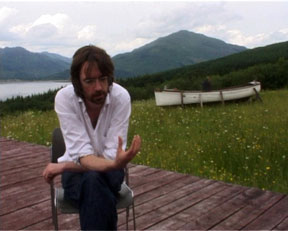
The interview with Starling was recorded at Cove Park on Sunday 2 July 2006, following a talk delivered at the Commission launch, Cove Park, 1 July 2006.
Autoxylopyrocycloboros took place on Wednesday 25 October 2006.
Ross Birrell: Could you describe your approach to research?
Simon Starling:My approach to research is very un-academic. I mean, it’s not structured in a way that would make sense within the normal understanding of academic research. It’s pretty shambolic, to be honest. It takes many, many forms. I mean, there is a degree of rooting around in libraries and that kind of thing, but it’s only one small part of the way that the research for each project develops. I don’t know, it’s a confusion of all sorts of verbal information, storytelling, things picked up in the pub, things stumbled upon by accident. You just develop a nose for what might at some point be significant. It’s like a big Velcro-covered ball or something and things stick on to it and sometimes they fall off and you lose them, and sometimes they become suddenly key to a particular project or context or… so yeah, it’s not a clear thing in any way, but it seems, it’s just the way it’s developed within the practice and it’s quite difficult to talk about because it’s so un-formalised. But perhaps that’s true of everybody.
RB: I’m interested in the role that luck plays in research. Around the Turner Prize last year there was much emphasis upon your work as ‘research-based’, whereas you described yourself more modestly as ‘just a lucky guy’. It’s as if people have forgotten that luck happens in a scientific laboratory as well, so what about legitimising ‘luck-based’ art; the role of luck seems to be excluded in any kind of framing of those kind of instrumental logics of rationality.
SS: There is a very real sense that you create your own luck. The laboratory analogy is a good one here. You create the conditions that allow for a somewhat unexpected and uncontrolled chain reaction to occur… these kind of coincidences, these sort of chance findings… it’s about identifying them when they happen, and sometimes that happens immediately and sometimes it happens much later on. Like I was saying yesterday in the talk about the development of this project for Cove, this meeting I had with my students at Faslane, the naval base, and this introduction to the whole history, the ethos and whatever of the naval base, which was completely bland in a way, the party line as it were, and then our guide, Commander Bill, suddenly shows us a clip from “Only Fools and Horses”, a bit of slapstick comedy which was I suppose intended just to lighten the mood or something. It’s something that at the time I didn’t really think so much about but then in retrospect it seemed to hold this kind of strange attraction for me, this sense of truth or something. It’s like Commander Bill was trying to tell us something, you know, very, very deep, very fundamental. It was an existential plea or something. I think I just carried the apparent pathos from that comic moment through into developing this slapstick, self-destructive project. It’s luck but it’s also just about identifying something’s significance.
RB: It strikes me that if luck happens in a laboratory situation, a scientist can’t trust it, they’ve got to verify it and repeat it…
SS: Yeah, yeah.
RB: Whereas in artistic research if luck comes, you trust it. You have to. That’s what makes the work kind of sing out in a way, those moments, and it becomes almost allegorical in a sense, that maybe the kind of slapstick moment is an allegory for fallibility. That brings up the comedic element to the work. Although there are certain artistic references in the work for Cove Park, like Bas Jan Ader’s In Search of the Miraculous, there also seems to be an amplification of that ACME kind of comic value that underpins a lot of your work.
SS: Perhaps in this project it’s at its most explicit, because the act in itself is so much like early Tom and Jerry or Mickey Mouse – it foregrounds those really violent early cartoons. It’s exactly that moment when Tom saws off the branch of the tree that he’s standing on. I guess I was trying to find some sort of space between the madness of the naval base but also that of the peace camp – their crazy canoe trips into the path of nuclear submarines to try to disrupt things and also just keep things in the press. I guess what I felt when I came here, particularly the first time with the students and visited the peace camp and Faslane, was that the rhetoric of both of these organisations seemed completely hollow or empty. I’m trying to, I don’t know, find some ground in the middle of all that that makes sense to me. Of course, the action on the water is something that has a relationship to political protest in a way, but it’s kind of… yeah. Perhaps it’s a sort of dramatisation of that or something. I don’t know exactly. I’m a big supporter of the peace camp but my work has to operate differently.
RB: It strikes me that, with the auto-destructive process involved in this work, there are some affinities with the work of Gustav Metzger. The immediate context here, geographically, is Coulport, the nuclear base, and for Metzger it was definitely the nuclear bomb to the extent that he went on the Aldermaston March, was on the Committee of 100 with Bertrand Russell, the origins of CND and the auto-destructive nylon painting, to watch it disintegrate was a comment upon the auto-destruction of Mutually-Assured Destruction policy.
SS: Yeah, yeah. No, that’s really interesting, that idea of a theatre of destruction, a catharsis if you like. [Ship’s horn sounds in background] They’re listening [laughs]. I was also thinking about Luddite protest, you know, that idea of destroying the technology that you perceive as taking away your livelihood, your job, and I suppose that notion is somehow… you know, there or thereabouts in a lot of the work, a kind of controlled aggression towards technology, in a way. I think that has a strong connection with Metzger too perhaps. If steamboats hadn’t been invented there would certainly be no nuclear submarines – its like a Luddite aggression against the submarines forefather. A Trident submarine is a steam-powered vessel too. I was thinking about this also in relation to Bas Jan Ader. His frame of reference was also rather un-contemporary in a way. It was almost sort of nostalgic or something, all those nods to the Casper David Friedrich and the like. I’ve always tried to find ways to use, you know, very outmoded, outdated kinds of technologies and conversations and ideas and try to give them some new life in relation to a contemporary understanding. Bas Jan Ader was also the fall guy too, riding his bike into and canal, trying to cross the Atlantic in a ridiculously small boat. The title of this project too, with its nod to alchemy, suggests an out-moded philosophy. To me alchemy is particularly interesting when understood in terms of process and not product. It’s not really about attaining gold from base metals but rather the mental space that that process allows – that utopia, if you like. Process over product, that’s the key.
RB: In that respect, in the way that Thomas More’s Utopia might be regarded as a political allegory, your experiments with alternative forms of technology become allegories, chemical and alchemical processes, which seem to comment upon contemporary debates around renewable energy supplies and sustainability, though never addressing politics directly, but politics – maybe a utopian politics – is somehow always there, latent within the poetry of the work.
SS: Yeah, it’s a sort of subtext, I guess. It’s funny how the work starts to collide with politics in quite surprising ways. I mean, suddenly, you know… in a way, since I started this project here, you know, again there’s this kind of big debate about both the future of the Trident fleet and nuclear energy in general and what role that has in trying to deal with global warming or all these kind of things and suddenly this project has a kind of new resonance in a way. It’s about trying to find a kind of space between a sort of poetic notion and a political one, and for those two poles, if you like, to always be in dialogue. Perhaps it’s the conceptual versus the existential or what have you. One of the things that I’ve been thinking about a lot over the last few years is this idea of a post-conceptual practice and how it’s possible to take some of the very clear, hard-won models from conceptual work, you know, from the sixties, seventies, perhaps, and to try to re-deploy them in a way, to give them a new life. I mean in a way I suppose the overwhelming sense of a lot of that work for me, while fantastically important historically, is that it became rather too self-referential, monastic in a way. But to me there’s so much fruitful material there to re-use in investigations of a slightly more outward-looking nature and perhaps a little bit more politicised, if you like -and not only the politics of art production either.
RB: The role of mediation seems to be crucial in underpinning that politics.
SS: Absolutely, yeah. If you take a work like Robert Barry’s Inert Gas releases, for example, these dematerialised gestures in and around LA in March 1969, what that work does in a very clear way is shift the ground from making/performing to mediating. The slightness or insignificance of the gesture lay this relationship open in a very powerful way. That is in itself a political statement, particularly viewed I relationship to a post ’68 awareness of the power of the media.
RB: In your talk yesterday at Cove Park, you mentioned that the mediation of Autoxylopyrocycloboros is an integral and crucial component of the work .
SS: Yes, absolutely.
RB: How will it be mediated? How will it be experienced?
SS: It’s evolving, I think, and I’m trying to let it, as much as possible make itself, in a way. I always feel that with the best work it feels as if it could only be that way – that’s the goal. It has such a clear structure as a performance, if you like, as an action, that I thought it would be nice to build a little bit of space into how it manifests itself in the end and to document and record everything, but then to try and take a step back from that and see how that can be… sort of re-worked, re-presented. So I just feel, I think in a way it’s a little bit off the point, but I feel more and more that there’s, as you say in this kind of culture of spectacle that is sort of engulfing everything, I mean, the art world as much as anything else but, that it’s quite nice to build this kind of sense of distance and mediation into the way you present the work, so you don’t become a kind of clown in a way. And I think it’s been a frustration to people at times in the way that I work, that they feel like they’re not getting everything, they’re not getting the real thing or that somehow what they get is the remains, the kind of mediated remains of something, and… you really felt that, actually, around the kind of discussion around the Turner Prize show. There was a sort of frustration there and a suspicion of work that perhaps uses, you know, a text to give it shape. The Turner Prize, has made me much more resolute in that respect, to really try and develop that side of the work. It’s a little bit of a response to the market as well at the moment, that… it’s quite nice to play a little bit with the sense of what is the art work, where is it, where does it exist? Is it in the action on the water or is it in the documentation of that, and to keep that question as live as possible.
RB: I mean, there’s kind of an obvious parallel in my mind to some of the strategies of Gordon Mark Clark. I mean, just the multiplicity of approaches and then of the remnants, the remains, the designs, the drawings, whatever. But also your interest of his interest in kind of ‘anarchitecture’, kind of anarchic approach to deconstructing architecture, and then the piece that you were referring to that was in the Turner Prize was the piece that was done for Basel first of all, which was this kind of mobile architecture. And the will to remain mobile within the practice itself seems also to be parallel.
SS: And in a way I think perhaps, you know, Matta Clark’s probably suffered a little from dying so young, in a way. I think what’s happened to his work is that it has become, to some degree… I mean, you see gallery shows of his work now and they’re always awful kind of compromised things. You know, you feel that probably now you feel the greatest sense of connection with him in the films that he made. Certainly, he’s one role model in a way, but also of course someone like Robert Smithson, who also worked with this notion of mediation in a very, very complex way. I mean, I can’t begin to touch that, but you know, things like the Spiral Jetty and the movie about the Spiral Jetty. The Spiral Jetty being this almost unattainable, invisible thing that’s as much about anecdote as it is about anything else, and then this film which creates this fantastic, complex, galaxy of ideas around that very tough gesture. That’s was really something.
RB: There’s a proximity with Smithson here, but there’s also an important development and difference. The circularity of the oroboros is different from the spiral, and whereas the spiral might be funny because you end up nowhere and you kind of see yourself going nowhere, the circularity here is not just in the circular motion of the boat, travelling in a circle around Loch Long, but it also introduces a relationship between origin and return in that the boat was originally from the bottom of a lake, Lake Windermere.
SS: It’s a return in that sense. No, I mean, again, it was one of those very lucky additions to the project, in a way, that we found a boat that had been salvaged from the bottom of the lake and given this rather cheesy name ‘Dignity’ as a result of that. It’s just sort of grist to my mill in a way, yeah, it’s another beautiful coincidence. And maybe some day it’ll come back up again. Who knows?
RB: You’ve no plans to exhibit its aftermath?
SS: Not at the moment, no. I think it would be a rather beautiful object, actually, in a way. I think especially probably if you left it down there a while, you know, for the mussels to grow and other things, but I don’t know. I think probably its absence is more powerful.
RB: Narrative seems to be integral to a lot of the work you have made. Although the object might appear fixed, it’s always in some sort of process of decay, the narrative seems to frame and suspend the object so that although you’re looking at, say, the boat ‘Dignity’ at Cove at the moment but also Shedboatshed, you’re looking at an object which contains the narrative of its own construction, deconstruction and re-construction – the marks of the saw, the numbered planks.
SS: Yeah, sure, you can read its history in its scars….start to piece that back together in your mind.
RB: So that even though you’re looking at something which ostensibly looks like a fixed object, it’s always held in some sort of larger narrative.
SS: Exactly. Which I suppose goes back to the discussion about mediation and how you deal with that, so no, for sure.
RB: I suppose the question is how that narrative relates to the visual, to the composition, to the aesthetic?
SS: Yeah. I think in one sense the work that I make, has a very clear, traditionally sculptural sensibility, the investment in the object is very important … and I think that’s a result of the sense of trying to sort of… trying to make the work magnetic enough or something for people to stay with it and to live with it and to then engage with this constellation of stories and ideas that surrounds it all, and that the object, you know, the shed in the museum in Basel, it’s a kind of… yeah, it’s sort of carrying that stuff with it, I mean not in an explicit way, but the scars and the holes and the marks are like some strange cipher or something for gaining access to the bigger picture, the bigger project, and I think the particularities of the objects that I’m deploying in all of these actions or performances, they’re very important. I love the fact that that’s so often out of my hands, in a way, that formally the works make themselves, they take on their own life.
RB: Why the recurrence of the use of boats; for example, in Blue Boat Black at Transmission in ’97, the transformation of that boat, the origin of which was the vitrine, in Shedboatshed the shed was transformed into a boat, but you’ve also used boats like the Loch Long piece for Saõ Paolo and this work for Cove?
SS: On one level it’s very simply about making some kind of a journey and boats are one thing you can do that on, you know, bikes also, cars, you know? On a fundamental level the work’s about trying to connect things, connect histories, connect places, connect ideas and somehow the vehicles are a sort of integral part of that process, on a figurative level, perhaps. Often you actually don’t get anywhere in your journey, you know? I made this project some years ago [Camden Arts Centre, 2001] where I made a solar-powered trip on a little electric moped that I had built, from one d’Habitation building to another across France, and you sort of ended where you began in some way. The d’Habitation buildings are raised above the landscape, they are like vast ships in a bucolic landscape, and somehow it seemed like a nice thing to try and connect those two doppelgangers. They’re also oriented in relation to the sun in exactly the same way in Brie en Forêt, Marseilles and Rezes, and my little tent with its three solar panels had to be also oriented in relation to the sun to make the journey possible. But you end up where you began, in a very real way and a linear journey becomes a closed circle.
RB: This brings us back to where we began, in a way, in terms of research. And maybe in contrast to what I was saying about luck earlier, there’s a specificity to a lot of your work where there’s a specific design or specific knowledge that you must have in order to be able to conduct the journey or what will be the outcome of this engine or how will this operate, so there is obviously a significant amount of planning and research.
SS: I tend to have a very clear sense in my head about the manifestation of the work before it happens. There seems to be only one way it can be. For Katkeenhaus, for example, I had a very clear picture of, you know, a Volvo engine and a cactus in a space, and the Volvo engine heating the cactus, and it’s about getting to that point down the road, but you have to have the very strong idea in your head before you can embark on the journey. But its not always a picture generated from a great amount of knowledge, it tends to be speculative to some degree, a leap of faith if you like. Then the research and planning begins. That’s when the project starts to take on its own life. I never set out to have a research-based practice it just happened and it worries me a little how formalised that kind of thinking has become within institutions.
RB: I like the idea of a ‘leap’ into research, like Klein’s Leap into the void – not knowing where it’s going to go but trusting that the journey itself will be worth it, like knowing an instrument well enough in advance to allow you to improvise, or knowing how to react when luck happens.
SS: Yeah. Like carrying around with you a rucksack of experience and knowledge, also a nose for things that you develop over the years. I think it’s as much that as research.
RB: Like connoisseurship?
SS: Yeah, you can smell it, kinda thing.
RB: It also doesn’t really seem to need to make any sense.
SS: But you have to hold onto that, I think, that lack of sense somehow.
RB: When you showed the slide of the installation of Blue Boat Black in Leipzig, the text on the wall with the names of the different fish which you had caught, had, to me, certain echoes of Ian Hamilton Finlay’s work. And although he foregrounds the political in very iconic ways which doesn’t necessarily chime to the same degree with your practice, Finlay still seems to be significant here, not only in terms of the mock-heroic and the ludic dimension already discussed but in terms of the relationship of a kind of poetic and political quality to the work.
SS: Yeah, also a concern with a sense of place or something – the projection of history onto landscape and landscape onto history. No, I think that’s absolutely right. I mean, maybe the obsession with movement and travel and journeys in the work is all about trying to establish a better understanding of a still situation, a static situation, a place, to respond to that. I mean, one of the things I didn’t talk about yesterday was that for some reason I keep coming back to these few square miles of Scotland around Cove Park. Of course it’s related to a social and economic structure that exists here, to a particular cocktail of things. In many ways it’s like the Tabernas Desert in Spain – a cocktail of growth and destruction, technology and nature, poetry and politics.
RB: And it’s not just the topographical, the geographical, but also it’s just what builds up there, what sediments.
SS: They become almost like allegorical places or something, I don’t know. I think perhaps in the case of both Cove and the Tabernas, there’s a sense of premonition or something in those places, that they’re almost a projection into the future. That I find very interesting. This struggle in the Tabernas Desert to stop the desert growing which is happening for climate change reasons and for bad land use reasons, the construction of this multi-million euro solar research place to try and make salt water into fresh water to irrigate the land, then the bizarre mock-Hollywood, mock-Texas Leone thing. It’s sort of tourism mixed with real, hardcore agricultural economics and ecology, and for me it’s a really heady mix, and I suppose that the attempt is to try and sort of distil some of that into work’s like Kakteenhaus and Autoxylopyrocycloboros.
END.